
Infrastructure-Free
Resilient Mesh
Blockchain Protocol
SuperLexicon is a Distributed Synchronized-by-Radio State Machine—an infrastructure-free blockchain that operates independently of the Internet, ISPs, physical switches, and the TCP/IP stack. Designed to execute deterministic state transitions directly over raw radio airwaves within a 500m–2km radius, powered by ultra-low-power radio (16–158mW).
Censorship & Control
Traditional networks rely on government-monitored gateways and corporate DNS routing. This makes standard systems highly vulnerable to centralized shutdowns, firewall blackouts, and state-level traffic control.
Infrastructure Failure
Standard blockchain nodes depend on physical routers, hardware switches, and global TCP/IP backbones. If physical fibers are severed or public power grids fail, validator coordination immediately halts.
Single-Window Byzantine Quorum Receipt
Traditional LPWANs rely on unconfirmed ALOHA bursts (zero ACKs) or suffer from colliding P2P/P2MP ACKs. SuperLexicon introduces Single-Window Byzantine Quorum Receipts (BFT-ACK): executing leaderless 4-phase consensus directly over raw RF to generate a multi-party signed Quorum Certificate (QC_Proof) within a single timed window—eliminating P2P ACK storms and ALOHA collisions.
DDoS & Penetration
Conventional nodes expose open IP addresses and RPC ports to the global internet, inviting remote botnet volumetric floods and exploit penetration. Physical radio propagation limits remote network attack vectors, reinforced by 4-phase fair-share consensus.
Pluggable Multi-Transport Topologies
SuperLexicon separates physical network transport details from the core consensus business logic. The `TransportRouter` directs traffic across multiple radio and IP-based backends.
LR2021 FLRC Radio (Primary Transport)
The primary physical transport for local mesh deployment. Communicates over USB CDC with an nRF54L15 MCU executing burst radio firmware at 915 MHz with 1.2 MHz bandwidth, routing frames directly across a dual-antenna RF path.
- Max Air Pacing: ~46 µs / byte
- Packet Splitting: 500B (votes) / 600B (blocks)
- Interframe Delay: 1200 µs (minimum)

LAN IP Multicast
High-bandwidth local network transport. Bypasses radio limitations to simulate sub-millisecond local validator roundtimes.
- Protocol: UDP Multicast / TCP Fallback
- Throughput: Gigabit LAN line rate
- Use Case: High-performance private validation
WAN Fallback
Standard WAN internet transport using libp2p. Includes Noise secure channel, Yamux stream multiplexing, and Kademlia DHT peer lookup.
- Security: Noise Handshake (secp256k1)
- Gossip: libp2p GossipSub Channels
- Protocols: TCP / WebSockets
Recommended Consensus Phase Timings by Transport Backend
Core consensus phase durations are highly dependent on the underlying transport backend's capacity, airtime limits, and network latency profile. Recommended timings for a standard 4-validator network:
| Transport Option | 1. Txns Propagation | 2. Selection Votes | 3. Block Proposals | 4. Block Broadcasting | Total Round |
|---|---|---|---|---|---|
| LR2021 FLRC Radio | 5.0s | 1.2s | 1.2s | 1.5s | 9.9s |
| LAN IP Multicast | 0.05s | 0.03s | 0.02s | 0.02s | 0.12s |
| WAN TCP/IP Fallback | 0.6s | 0.4s | 0.2s | 0.2s | 1.4s |
4-Phase Consensus & Virtual Token Ring
Observe the transaction propagation, selection votes, block proposals, and broadcast phases in a simulated 4-node network. Toggle Byzantine modes, simulate transaction loads, and inspect how consensus resolves in real-time.
Window Round Timeline
Independent Subnets & Distance-Vector Mesh Routing
Autonomous consensus domains identified by persistent 4-byte IDs, executing locally at zero fees, discovering multi-hop routes via periodic SubnetAdvertisements, and bridging state across both fixed UDP backhauls and mobile "Pokémon"-style physical roaming carriers.
Physical Roaming & Mobile Sneakernet Bridging
Harnessing physical human mobility as an organic inter-chain transport layer. Pocket and vehicular sovereign nodes dynamically discover, map, and bridge disconnected RF subnets across mountain passes, maritime corridors, and deep RF shadow zones without cellular, satellite, or internet infrastructure.
The "Pokédex" RF Discovery & Delay-Tolerant Carrier Pipeline
A courier node crossing an RF void carries cross-chain transactions in a persistent FIFO flash buffer, delivering proofs and discovering subnets upon proximity contact.
The "Pokédex" Discovery Engine
Operating in passive background listening mode on 868/915 MHz LoRa and 2.4 GHz FLRC, pocket sovereign nodes continuously log overheard SubnetAdvertisement beacons (Msg ID 13).
- Zero Radio Exhaustion: Passive listening requires zero TX chirps, preserving battery life on pocket nodes.
- Offline RF Cartography: Builds an autonomous atlas of 4-byte IDs, tip heights, and validator keys without GPS or internet servers.
- Spontaneous Peer Peering: Automatically adds newly discovered subnets to distance-vector routing tables upon contact.
Delay-Tolerant Sneakernet Relay
Implementing store-carry-and-forward routing (RFC 4838) over organic human and vehicular mobility. When subnets lack Line-of-Sight or IP backhaul, physical couriers serve as organic transport relays.
- Flash-Backed Queue: Outbox envelopes (
SubnetRoutedTxn) persist in non-volatile storage across hours or days of physical travel. - Proximity Flushing: Automatically injects buffered envelopes into target subnet rings when radio beacon handshake matches.
- Return Receipt Relay: Carries sealed
SubnetRoutedBlockconfirmation proofs back along the return journey.
Cryptographic Zero-Trust Invariants
Physical couriers are strictly untrusted carriers. All security invariants are enforced cryptographically at the protocol boundary rather than relying on courier integrity.
- Zero Validator Authority: Roamers hold no validator voting rights and cannot forge, modify, or censor ledger blocks.
- End-to-End Ed25519 Signatures: Transaction payloads are signed by origin user keys; byte alterations invalidate signatures instantly.
- (N - f) Quorum Proofs: Cross-chain receipts are authenticated via threshold Quorum Certificates, preventing replay or fabrication.
Subnet Maturity Determination & Buffer Prioritization
Because pocket nodes possess finite non-volatile flash storage, the engine computes a Subnet Maturity Score (M_s ∈ [0, 100]) from broadcast beacons to determine relay queue prioritization and prevent outbox buffer starvation:
| Tier | Maturity Score | Classification | Roamer Buffer Policy |
|---|---|---|---|
| Tier 1 | 85 – 100 | Sovereign Production | High-priority reserved flash buffer; guaranteed relay. |
| Tier 2 | 60 – 84 | Maturing Domain | Standard FIFO buffer; relay on next contact. |
| Tier 3 | 30 – 59 | Emerging Sandbox | Best-effort relay; subject to queue eviction. |
| Tier 4 | 0 – 29 | Ephemeral Testnet | Ephemeral transient cache only; 2-hour TTL drop. |
Binary Wire Protocol & Loop-Free Route Convergence
Roaming nodes exchange compact binary frames with subnet edge validators (src/consensus/subnet.rs) designed to fit within single LoRa/FLRC radio MTUs:
MAX_HOPS = 16 boundary alongside Split-Horizon and Poison Reverse, preventing transaction re-injection loops across bidirectional couriers.
Pluggable Virtual Machines
Depending on hardware deployment profiles, SuperLexicon configures alternative virtual execution sandboxes to isolate state mutations.
WASMtime Rationale
Designed for cloud validators and high-spec gateway nodes. Compilation to native machine code ensures that compute-heavy contracts (like cryptographic verification or complex loops) execute in sub-milliseconds, amortizing compile latency.
Embive Rationale
Designed for edge burst transmitters. The interpreter sandbox has virtual memory boundaries implemented directly in software. This avoids heavy memory manager states, enabling execution of tiny binaries directly on radio transceivers.
Comparison: WASMtime vs. Embive RISC-V Sandbox
WASMtime executes WebAssembly via AOT/JIT compilation on high-performance server/laptop nodes, while Embive executes 32-bit RISC-V bytecode directly on bare-metal silicon, optimizing for ultra-dense radio packets, sub-microsecond cold starts, and zero-heap microcontroller execution.
| Metric / Feature | WASMtime VM (WebAssembly) | Embive VM (RISC-V Sandbox) |
|---|---|---|
| Over-the-Air (OTA) Wire Size | 10 KB – 40 KB (Multi-packet fragmentation over RF) | 400 B – 1 KB (Fits in a single radio frame; < 5 ms airtime) |
| Engine Memory Footprint | ~15 MB – 30 MB (Requires dynamic heap allocator) | < 20 KB Flash, < 16 KB RAM (Pure `#![no_std]` zero-heap) |
| Microcontroller Feasibility | Incompatible (Requires MMU, mmap, virtual memory) | 100% Bare-Metal (Runs on Nordic nRF54L15 & low-power RV32 MCUs) |
| Cold-Start Instantiation | ~250 µs – 1.2 ms (Module parse, validation, linear memory) | < 1 µs (Instantaneous PC jump to static memory buffer) |
| Hardware Sandboxing Mode | Software virtual memory guards & dynamic bounds checks | Silicon PMP (Physical Memory Protection in RISC-V U-Mode) |
| Instruction Set Simplicity | Complex stack machine spec (SIMD, GC, exceptions) | 40 base RV32I integer instructions (Formally verifiable) |
| Target Hardware Tier | Server validators, laptops, base stations (SLX1 Host, SLX3) | Ultra-low-power field communicators & pocket terminals (SLX2, SLX3) |
Deterministic Smart Contract Environment
SuperLexicon smart contracts are compiled binaries optimized for low-bandwidth wireless transmission and predictable, sandboxed execution.
Supported Languages
Developers compile contracts in **Rust** (using the bare-metal RISC-V or WASM targets) or standard **C/C++**. Programs are compiled with `no_std` and zero memory allocation frameworks to run deterministically on low-power nodes.
Execution Safety
The execution runtime bans all non-deterministic operations. Floating-point operations, thread spawning, and hardware clock reads are disabled. All interactions with account states occur through safe, sandboxed system calls.
Deterministic Rust Contract Template
Rust (no_std)A template showing account state mutation and logging via host system calls:
#![no_std]
#![no_main]

// Link host system calls for state storage and events
extern "C" {
    fn sys_read_state(key_ptr: *const u8, key_len: u32, val_mut_ptr: *mut u8, val_max_len: u32) -> i32;
    fn sys_write_state(key_ptr: *const u8, key_len: u32, val_ptr: *const u8, val_len: u32) -> i32;
    fn sys_log(msg_ptr: *const u8, msg_len: u32);
}

// Entrypoint executed by the sandbox engine
#[no_mangle]
pub extern "C" fn execute() -> i32 {
    let key = b"counter_state";
    let mut buffer = [0u8; 4];

    unsafe {
        // 1. Fetch current transaction count from account state
        let bytes_read = sys_read_state(key.as_ptr(), key.len() as u32, buffer.as_mut_ptr(), 4);

        // 2. Increment transaction counter deterministically
        let mut counter = if bytes_read == 4 {
            u32::from_le_bytes(buffer)
        } else {
            0 // Initialize if state is empty
        };
        counter += 1;

        // 3. Write updated counter state back to persistent storage
        buffer = counter.to_le_bytes();
        sys_write_state(key.as_ptr(), key.len() as u32, buffer.as_ptr(), 4);

        // 4. Log completion event to block receipts
        let log_msg = b"Transaction count updated successfully";
        sys_log(log_msg.as_ptr(), log_msg.len() as u32);
    }

    0 // Return success status code
}

#[panic_handler]
fn panic(_info: &core::panic::PanicInfo) -> ! {
    loop {}
}
Contract Lifecycle
sl_deployBytecode JSON-RPC endpoint. The node stores the bytecode and returns a 32-byte code_hash (Keccak256).The Core Problems
Why a Distributed Synchronized-by-Radio State Machine is essential anywhere where infrastructure and trust is limited, and Single-Window Byzantine Quorum Receipts (BFT-ACK) are mandatory.
Real-World Domains: Where Traditional Radio Telemetry Fails
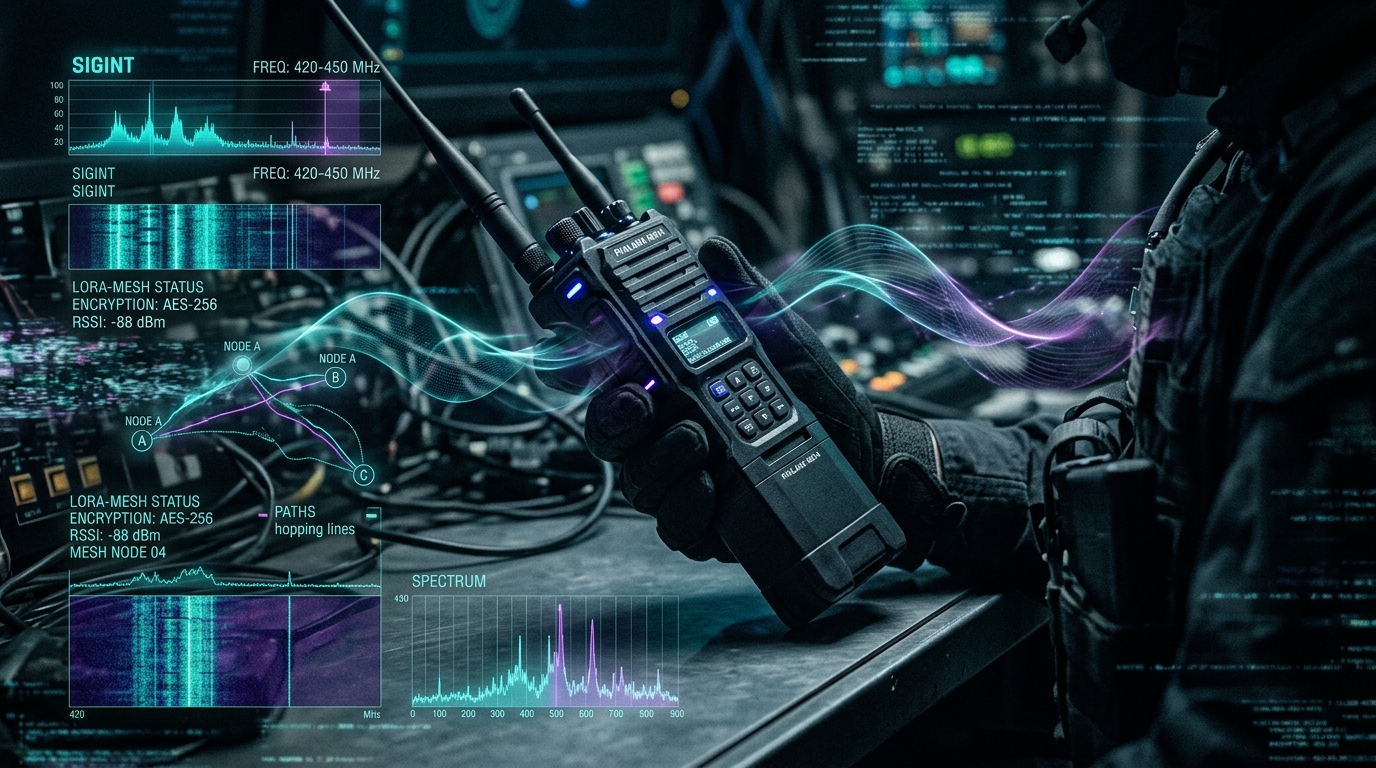
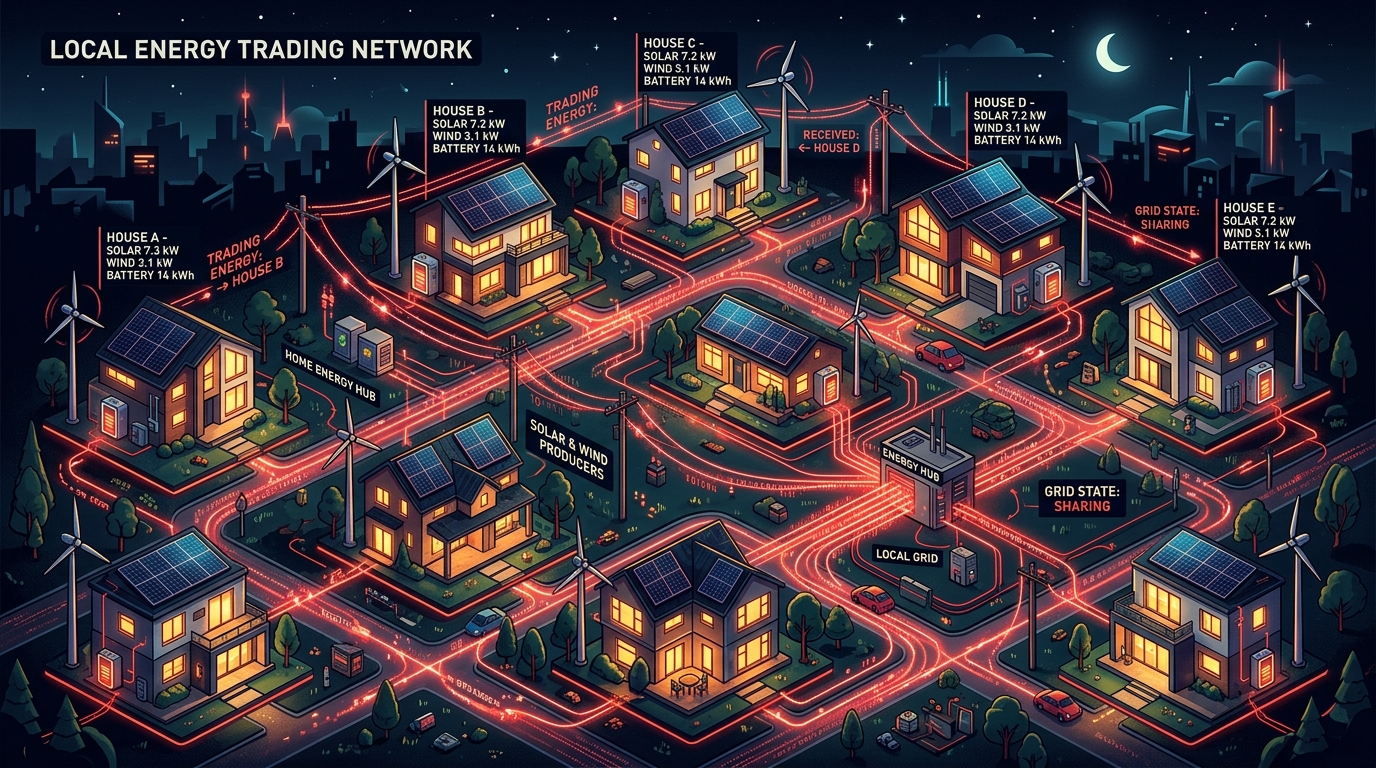
Peer-reviewed evaluations of LPWAN deployments in infrastructure-denied environments: what LoRa successfully accomplished over raw RF, and where uncoordinated telemetry breaks down without distributed Byzantine state consensus.





Existing Solutions
Why existing LPWAN technologies, ad-hoc wireless meshes, and broadband L1 blockchains cannot sustain autonomous off-grid consensus.
LoRaWAN and Sigfox rely on uncoordinated ALOHA channel access. Devices transmit blind uplinks to internet-connected gateways. Packets suffer on-air collisions, frame counters (FCntUp) are strictly per-device with zero cross-node ordering, and regional 1% downlink duty-cycle caps prohibit bidirectional consensus voting.
Networks like Meshtastic and Reticulum forward packets using ad-hoc flooding algorithms. While effective for uncoordinated text messages, they provide no distributed state machine, no global ledger, and no Byzantine fault tolerance. They are vulnerable to broadcast replay attacks, and cannot enforce monotonic account balances or smart contracts.
Helium and similar DePIN networks incentivize physical hotspots, but blockchain validation and consensus occur entirely off-device across cloud data centers (e.g. Solana / AWS). If regional cellular or fiber internet is interrupted, local hotspots cannot validate transactions, settle balances, or communicate peer-to-peer over the air.
Architected for high-speed fiber backbones, multi-gigabyte bandwidth, and heavy 32-core server validators with 64GB+ RAM. Their gossiping mechanisms rely on full TCP/IP routing with O(N²) connection streams. They are physically inoperable over low-bandwidth half-duplex RF airwaves (1.3 Mbps / 250 kbps) or embedded microcontrollers.
Architectural Comparison Matrix
Contrasting SuperLexicon's radio-defined blockchain against traditional blockchains and mesh overlay networks.
| Architectural Dimension | Traditional L1 Blockchains (Ethereum / Solana) |
Mesh Overlay Networks (Helium / Meshtastic) |
SuperLexicon Protocol (Distributed Synchronized-by-Radio State Machine) |
|---|---|---|---|
| Underlying Physical Transport | Fiber Optics, Global Internet, Data Centers | Internet-tethered gateways / LoRaWAN | Raw Radio PHY/MAC (FLRC / Sub-GHz) |
| Network Infrastructure Required | Routers, switches, ISPs, DNS, BGP | Cellular backhauls & cloud servers | Zero (No internet, no servers, no switches) |
| Networking Stack | Full TCP/IP & Socket layers | UDP / IP encapsulation or raw flood | Bypasses TCP/IP completely (Raw SPI/UART) |
| Consensus Topology | Multi-round unicast gossip (O(N²) streams) | Centralized coordinator / PoC beacons | P2MP Hardware Broadcast (1-to-many over RF) |
| Consensus Engine | Gasper / Tower BFT (Heavy voting) | None (Best-effort flood routing) | Time-Slotted 4-Phase (8-Step) Single-Window |
| Smart Contract Sandbox | EVM (Monolithic) / Sealevel (eBPF) | None (Packet payload only) | Wasmtime AOT + Embive Bare-Metal RISC-V |
| Transaction / Gas Fees | Mandatory dynamic fee auctions ($Gwei) | Data credits / Transit token burning | Completely Free (Zero user fees; computational utility) |
| Off-Grid Survivability | Zero (Halted upon internet severance) | Low (Mesh messages only; no ledger/settlement) | 100% Autonomous (Self-contained over raw RF) |
Traditional distributed state machines (Ethereum, Solana, Tendermint) are synchronized-by-TCP/IP across cloud data centers, failing the instant fiber connections or NTP servers drop. Conversely, ad-hoc wireless meshes (Meshtastic, Reticulum) are uncoordinated packet forwarders with zero distributed state machine. SuperLexicon features a leaderless architecture where slot pacing, mempool synchronization, transaction ordering, and Byzantine state finality are synchronized directly over-the-air via RF broadcasts—delivering deterministic state consensus without internet or telecom backhauls.
Our Software
Complete open-source codebase directory spanning bare-metal radio drivers, device UI apps, consensus daemons, and RTOS HAL ports.
Official Open Source Repositories
SuperLexicon core protocol monorepo, bare-metal hardware drivers, OSINT servers, and HAL forks.
Core Protocol Monorepo: Verkle State Trie, 4-phase BFT consensus engine, Wasmtime & Embive VM runtimes.
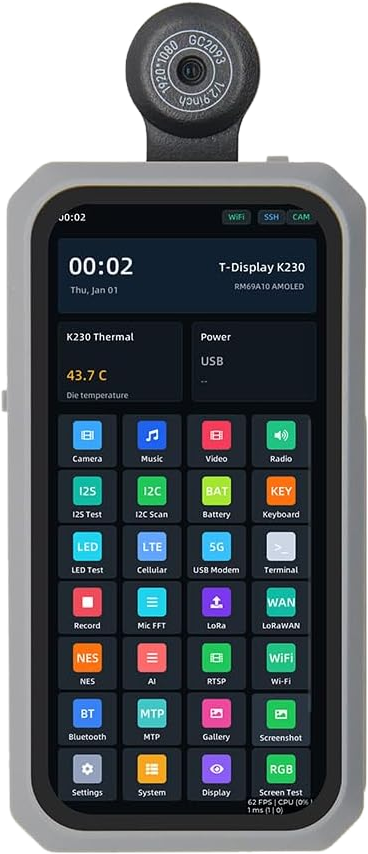
Bare-metal LR2021 blockchain radio driver & transceiver engine written for LilyGO T-Display K230 hardware.
Native Sovereign Communicator UI application for LilyGO T-Display K230: RF telemetry monitor, key management & Pokédex atlas.
nRF54L15 MCU firmware: Dual-band 2.4 GHz FLRC radio modem, binary framing over SPI CDC, dual-antenna fast diversity.
Decentralized OSINT server: Facial proof-of-life, optical document analysis, Shamir's Secret Sharing (SSS) social recovery.
Semtech USP HAL fork: Exposes smtc_modem_hal_radio_irq_kick() to resolve edge-loss during frequency retuning.
Reference Hardware
Commercially available open-hardware reference platforms maintained for immediate community deployment and early developer testing.
Our Hardware: The SLX Series
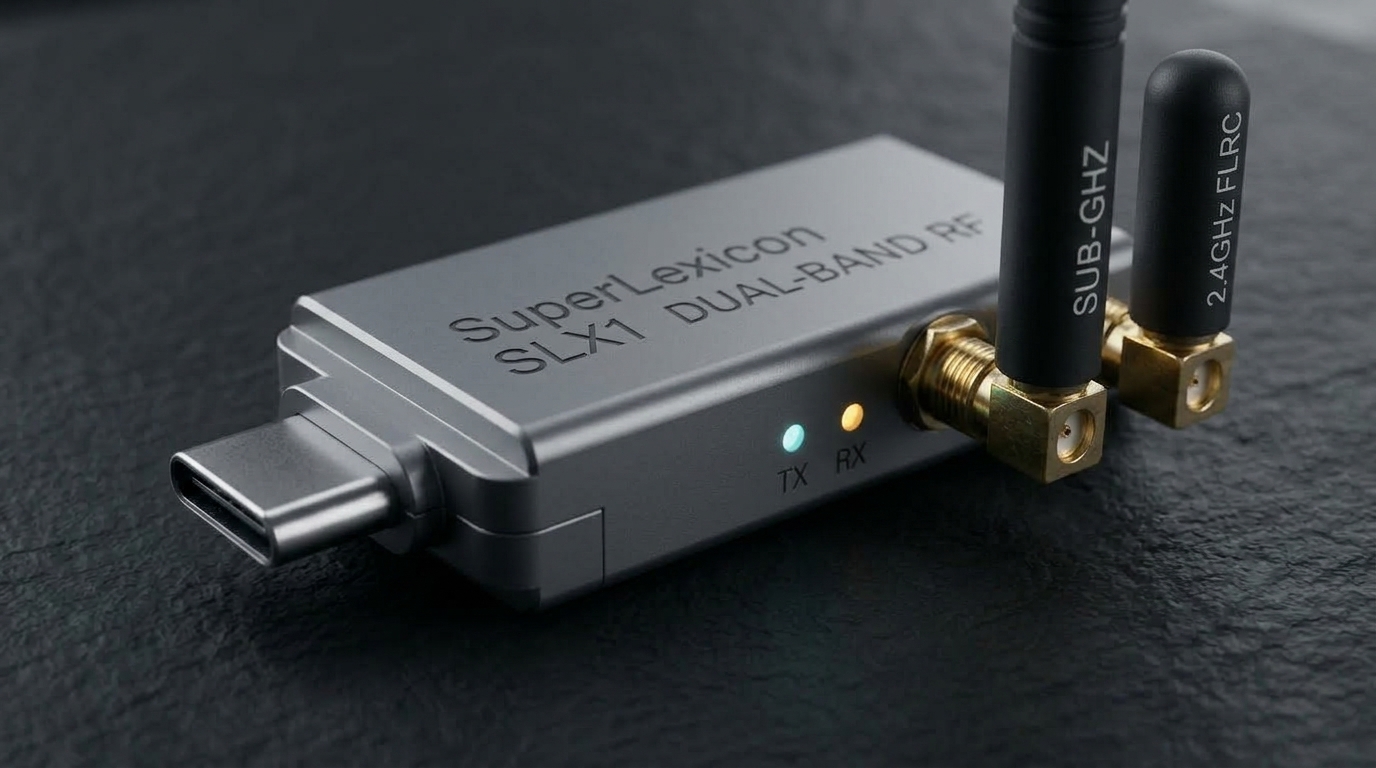
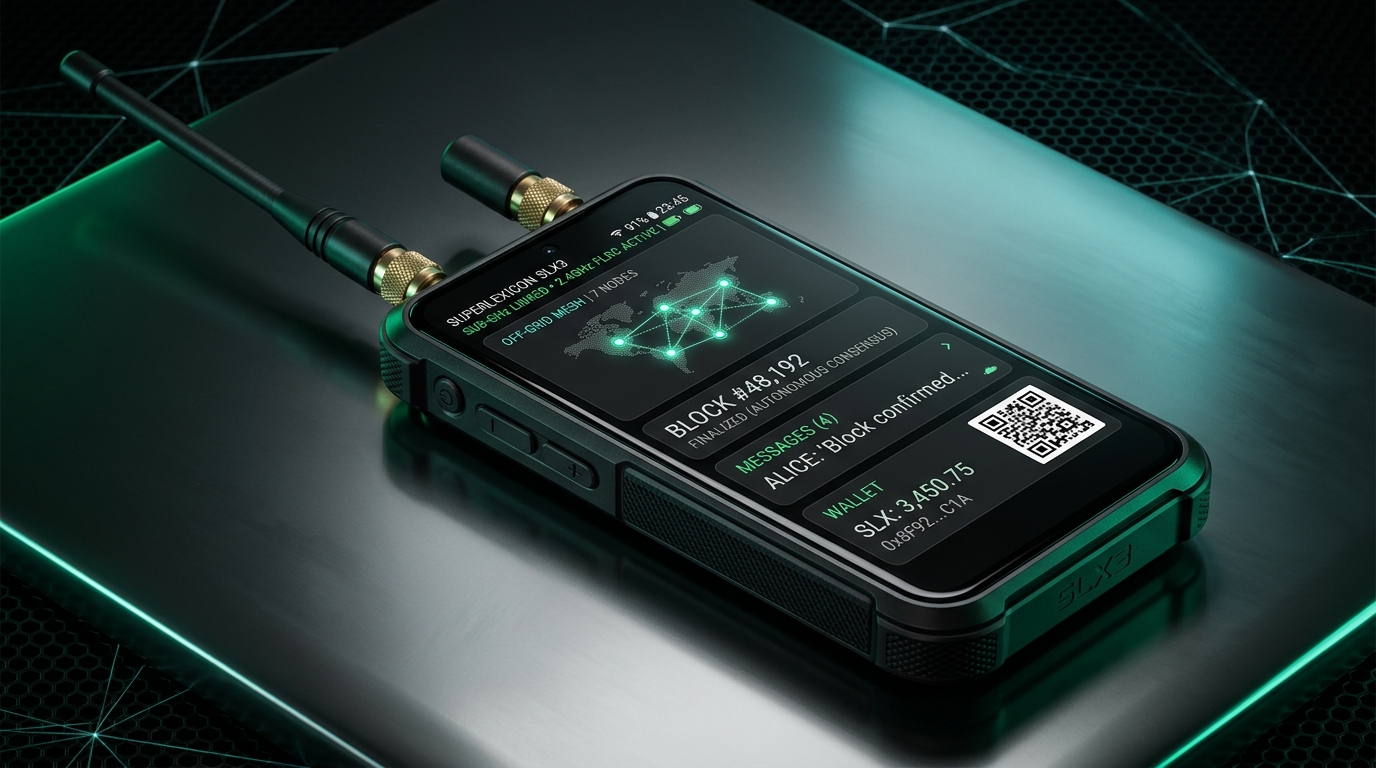
A tiered spectrum of purpose-built radio consensus terminals engineered for physical survivability—from host-tethered dongles to autonomous handheld computers.
RF Resonance & Dual-Band Antenna Engineering
Every SLX device prominently features dedicated dual external antennas derived directly from RF wavelength physics (λ = c / f). A longer quarter-wave whip element (λ/4 ≈ 8.2 cm) penetrates dense foliage and topography at Sub-GHz (868/915 MHz) for wide-area mesh backhauls, alongside a compact stub element (λ/4 ≈ 3.1 cm) delivering high-throughput (1.3 Mbps) localized 2.4 GHz FLRC BFT consensus bursts.

Hardware Spectrum & Execution Tiers
Architectural alignment and compute strategy across the SLX hardware lineup.
| Specification | SLX1: USB Dongle | SLX2: E-Ink Companion | SLX3: Sovereign Communicator |
|---|---|---|---|
| Operational Role | Host-Tethered Radio Front-End | Autonomous Ultra-Low-Power Field Node | 100% Zero-Host Sovereign Tactical Node |
| Compute Architecture | Nordic nRF54L15 MCU + Host PC/Laptop | Low-Power RISC-V MCU (400 MHz RV32) | 64-bit Quad-Core RISC-V SoC (1.5 GHz) |
| Smart Contract Execution | Executed on Host (Wasmtime / Embive) | Bare-Metal Embive RV32I (<20KB) | Native Wasmtime + Hardware Silicon PMP |
| State Storage Strategy | Full RocksDB Historical Archive (Host) | State-Pruned Verkle Tree Root (RAM) | Full Local RocksDB On-Device Archive |
| Consensus Timeliness | ~0.4 ms (Instantaneous) | ~1.6 ms (100% Latency Parity) | ~0.4 ms (Instantaneous) |
| Display Interface | Host Monitor / Terminal CLI | Monochrome Sunlight-Readable E-Paper | Edge-to-Edge Full-Color AMOLED Touch |
| Power Source & Autonomy | USB-C Bus Powered (<150 mW active) | Weeks of Standby (Ultra-low sleep) | 24–36 hrs Continuous (5000 mAh internal) |
Hardware Scaling Calculus: Prototype Half-Duplex vs. Production 2x2 MIMO
Current testnet telemetry, phase boundaries (6.0s–18.0s), and simulator metrics reflect the conservative operational bounds of our first-generation half-duplex development prototype (Semtech SX1280 / Nordic nRF54L15). The production hardware roadmap upgrades the platform to a Dual-Band 2x2 MIMO Concurrent Transceiver Architecture with simultaneous Sub-GHz long-range mesh and 2.4 GHz FLRC consensus.
| RF Architecture Metric | Dev Prototype (Single Half-Duplex) | Production Roadmap (Dual-Band 2x2 MIMO) |
|---|---|---|
| RF Front-End Chains | Single Transceiver (Strict TDD Half-Duplex) | Dual Independent Transceivers (>45 dB Isolation) |
| Physical Air Bandwidth | 1.3 Mbps (Uncoded SISO FLRC) | 2.6 Mbps (Spatial Multiplexing MIMO FLRC) |
| Turnaround Deadtime ($T_{ ext{turn}}$) | 1,200 μs hardware floor per slot transition | 0 μs (Continuous full-duplex pipeline) |
| Mempool Dissemination (Phase 1) | Serialized blocking slot (1,500–4,000 ms) | Pipelined background reception on Sub-GHz (0 ms blocking) |
| Consensus Round Window ($T_{ ext{window}}$) | 6,000 ms (Nominal) to 18,000 ms (Expanded Window) | 800 ms – 1,200 ms (5x–15x compression) |
| Block Finality Latency | 6.0 – 18.0 seconds | 0.8 – 1.8 seconds (Sub-2-second finality) |
| Block Payload Capacity | 32 transactions / block | 64 – 128 transactions / block |
| Sustained Network Throughput | 1.8 – 5.3 TPS | 35.0 – 65.0+ TPS (Peak: ~106.7 TPS, ~12x speedup) |
Hardware & Software Dual Revenue Engine
SuperLexicon drives protocol economic value through dual revenue streams: physical hardware terminal sales (SLX1–SLX3) and enterprise software licensing, DePIN data market royalties, and CLOB trading fee settlements.
Gross Mesh Product (GMP) vs. Speculative Inflation
Economic ParadigmTraditional DePIN & L1 protocols print unbacked inflationary block rewards, driving token prices purely on speculative expectation of future use. When speculation fades, miners dump printed tokens, causing an inflationary death spiral.
Hardware Revenue & Token Allocation Tiers
Selling physical terminals powers protocol engineering, open-source R&D, and physical node density.
Dual-Band USB Dongle
Sub-GHz + 2.4 GHz FLRC consensus radio modem front-end for laptops, workstations, or tactical servers.
E-Ink Pocket Companion
Ultra-low-power RISC-V MCU terminal with sunlight E-paper display, bare-metal Embive VM, and weeks of standby.
Sovereign Communicator
Quad-core 64-bit RISC-V SoC with AMOLED touchscreen, on-device RocksDB, zero SIM, and 100% zero cloud dependency.
Software Revenue Streams & Application Licensing
Generating recurring protocol revenue through enterprise subnet licensing, DePIN data market royalties, and CLOB trading fee settlements.
Enterprise Subnet Licensing
Private mesh subnet licenses and custom Embive RISC-V ruleset deployments for defense contractors, government agencies, and industrial fleets.
DePIN Data Market Royalties
Protocol-level revenue sharing from off-grid IoT telemetry queries, environmental sensor feeds, and radiation/weather monitoring oracle access.
CLOB Trading Protocol Fees
Fractional protocol liquidity fees collected when off-grid limit order batches execute and settle onto the 1-year Ethereum CLOB contract.
Embive SDK & Developer Tooling
Commercial AOT compiler plugins, static analysis suites, and zero-heap verification toolkits licensed to institutional application builders.
Smart Contract Application Builder Rewards
Rewarding developers with $SLXR token grants for deploying high-utility Embive RISC-V & Wasmtime smart contracts that drive radio mesh protocol usage.
Discrete Time CLOB DEX Engine
Natively compiled RISC-V limit orderbook matching engine for off-grid peer-to-peer asset trading with zero MEV front-running, settling onto the 1-year Ethereum CLOB contract.
Tactical Emergency Dispatch
Automated casualty triage, medical unit routing, and emergency resource management contracts verified with BFT Proof-of-Receipt (PoR) confirmation across offline subnets.
DePIN Sensor Oracle Market
Off-grid IoT telemetry contracts monetizing environmental, agricultural, and power grid sensor data feeds over Sub-GHz radio links.
Zero-Gas Retail Point-of-Sale
Offline-first merchant checkout contracts, voucher escrows, and peer-to-peer local micro-settlement for communities facing connectivity blackouts.
Proof-of-Life & OSINT Vault
Cryptographically signed proof-of-existence, disaster audit trails, and localized media provenance verification anchored to subnet blocks.
SuperLexiconRewards.sol only after obtaining multi-peer cryptographic sign-off.
EMS Scale Mitigation & On-Chain Claim Architecture
Initial device manufacturing commitments lack volume economies of scale. Early adopter reward tokens offset unit cost overheads and are claimed via Ethereum Mainnet.
EMS Manufacturing Scale Mitigation
As with any new hardware technology, initial device sales start at modest volumes. Consequently, initial manufacturing commitments to our Electronics Manufacturing Service (EMS) partners do not yet possess high-volume economies of scale. To mitigate early unit cost overheads, early adopters receive reward tokens ($SLXR) paired with their device.
Device Activation & On-Chain Reward Claiming Workflow
Hardware Keypair Generation
Upon first power-up, the device TRNG generates a cryptographic keypair (SK_device, PK_device) stored in hardware-isolated flash.
Public Key Cryptographic Binding
Device signs an activation payload with SK_device. The device owner submits the signature alongside their verified purchase order proof.
Rewards Contract Minting
The SuperLexiconRewards.sol smart contract on Ethereum Mainnet mints $SLXR reward tokens directly to PK_device.
1-Year Holding Period & On-Chain CLOB Attachment
Reward tokens are held for a 1-year lockup period. Upon maturity, the world's only MEV-proof Discrete Time Central Limit Orderbook matching engine smart contract will be attached directly to the Rewards Smart Contract on Ethereum to make $SLXR fully exchange-tradable.
MEV-Proof Discrete Time Matching Engine
Replaces predatory continuous double auctions with discrete-time batch auction matching. All orderbook bids and asks within discrete time windows execute at a single uniform clearing price, rendering front-running, sandwich attacks, and MEV extraction impossible.
Ethereum Mainnet Contract Binding
Exactly after 1 year, the Discrete Time CLOB smart contract is attached directly to SuperLexiconRewards.sol on Ethereum Mainnet. Hardware owners and network liquidity providers gain direct, non-custodial exchange-tradable liquidity.
Interactive CLOB Trading & Liquidity Simulator
Adjust annual device sales volume and projected daily DEX volume to model $SLXR market liquidity and batch clearing price.
Full Disclosure: Lockup Period & Exchange Trading Risk
Reward tokens are subject to a strict 1-year holding period. Full disclosure: $SLXR reward tokens cannot be traded immediately upon device activation. Secondary market liquidity and pricing are unlocked after 1 year when the MEV-proof Discrete Time Central Limit Orderbook matching contract attaches to SuperLexiconRewards.sol on Ethereum Mainnet.
Bulk Purchaser & Subnet Builder Guidelines
Large device orders are welcomed for accumulating tokens, but buyers are expected to actively promote local deployment, build community networks, and offer or lend devices.
Active Subnet Deployment
Bulk purchasers must actively promote the deployment of purchased devices to form active local radio subnets rather than hoarding dormant hardware in storage.
Community Building
Buyers are expected to foster local user communities, organize mesh field tests, and support decentralized radio communications in their geographic region.
Device Offering & Lending Pools
To maximize physical mesh coverage, buyers are encouraged to lend, subsidize, or offer terminals to local operators, emergency networks, and field units.
SuperLexicon Timeline & Deliverables
Quarter-by-quarter breakdown of core engineering achievements completed so far and future milestones in active development.
Bare-Metal Radio Hardware Firmware & MAC Layer
- Bare-Metal Transceiver Drivers: Formulated raw SPI/UART drivers for Semtech SX1280 (2.4 GHz) & Nordic nRF54L15 transceivers.
- Dual-Band PHY Framing: Implemented time-slotted physical MAC windows across Sub-GHz (868/915 MHz) and 2.4 GHz FLRC radio airwaves.
- TRNG Keypair Generation: Integrated hardware-isolated True Random Number Generator keypair generation directly on bare-metal microcontrollers.
Protocol Version 1 Leaderless Consensus Engine
- Distributed State Machine (DSR-SM): Engineered an infrastructure-free 4-phase leaderless consensus round loop.
-
Deterministic Ordering: Formulated canonical in-block transaction sorting by
(sender, nonce)to eliminate transaction re-ordering attacks. - Bit-Identical State Roots: Verified state root hash calculation across isolated nodes over raw RF broadcast without TCP/IP.
Distributed Testnet & Technical Whitepaper
- Live Testnet Telemetry Dashboard: Deployed multi-node bench testnet monitor showing live slot pacing & RF packet loss simulation.
- 150+ Page Whitepaper Spec: Published and open-sourced whitepaper covering Verkle tree state pruning & bare-metal Embive RV32I execution.
- Zero-Gas VM Contracts: Demonstrated zero-gas smart contract execution across isolated radio mesh nodes.
EMS Partner Selection & Scale Manufacturing
- EMS Facilities Selection: Finalizing contract with premier Electronics Manufacturing Service (EMS) facilities for mass assembly.
- DFM & SMTA Tooling: Establishing Design for Manufacturability guidelines & surface-mount assembly (SMTA) tooling stackups.
- Antenna Impedance Tuning: Calibrating dual-band SMA antenna impedance matching for SLX series terminals.
Hardware Device Global Pre-Sales Launch
- Model SLX1 (USB Dongle): Opening global pre-orders for $149 MSRP Dual-Band FLRC/LoRa USB node terminal.
- Model SLX2 (Tactical Companion): Launching $299 MSRP E-Ink sunlight-readable mesh radio communicator.
- Model SLX3 (Sovereign Phone): Launching $599 MSRP integrated radio smartphone terminal with hardware isolation.
Community Subnets & Mainnet Reward Tokens
-
Reward Contract Deployment: Deploying
SuperLexiconRewards.solsmart contract on Ethereum Mainnet. -
Device Reward Tokens ($SLXR): Device setup registers public keys (
PK_device) to issue 1-year early adopter tokens. - Turnkey Subnet Kits: Releasing field deployment kits for regional emergency microgrids & municipal mesh teams.
Alternative Backhauls & Satellite Bridges (Starlink)
- Starlink Gateway Bridges: Engineering hybrid cross-mesh gateways integrating Starlink satellite terminals.
- Cellular LTE-M & HF Relays: Deploying cellular LTE-M failover backhauls and long-range High-Frequency (HF) radio relays.
- Inter-Subnet Global Sync: Syncing state across geographically isolated continental radio meshes into one global machine.
1-Year MEV-Proof CLOB Attachment & Secondary Trading
-
1-Year CLOB Smart Contract Attachment: Attaching the world's only MEV-proof Discrete Time Central Limit Orderbook matching engine smart contract to
SuperLexiconRewards.solon Ethereum to enable decentralized exchange trading. - Autonomous M2M Payments: Enabling machine-to-machine micro-transactions over radio without centralized gateways.
- Global Node Scale: Expanding infrastructure-free radio mesh network to over 100,000 active hardware terminals.
Forging the Decentralized Frontier
We are a collective of distributed systems engineers and radio frequency enthusiasts who believe your messages should not need to travel around the world to get to the person 100m away from you.
Superlexicon is both the research arm and open source software line of IMMIN, a software engineering company that thrives at the intersection of distributed systems and investment finance, helmed by Mano Thanabalan.

Mano Thanabalan
Chief Technology Officer
Privacy Policy
Last Updated: August 27, 2026
SuperLexicon ("we", "our", or "us") respects your privacy. This Privacy Policy explains our practices regarding the collection, use, and disclosure of information when you visit our website.
1. Information Collection
We do not require user registration. We do not actively collect, store, or process any personally identifiable information (PII) from our visitors. Our website is designed solely for informational and research purposes.
2. Cookies and Tracking
This website uses only essential cookies required for basic site functionality. We do not use third-party tracking, analytics cookies, or advertising pixels.
3. Data Security
While we do not collect personal data, we utilize standard industry practices to ensure the security of our website's infrastructure.
Terms of Use
Last Updated: August 27, 2026
By accessing or using the SuperLexicon website, you agree to be bound by these Terms of Use.
1. Informational Purposes Only
All content provided on this website is for informational and educational purposes only. The SuperLexicon protocol is an experimental, open-source research initiative into decentralized internet topologies.
2. Intellectual Property
Unless otherwise stated, the concepts, whitepapers, and software architecture described here are open-source. However, the specific branding, website design, and logos are the property of the SuperLexicon research team.
3. No Warranties
The website and its contents are provided on an "as-is" and "as available" basis without any warranties of any kind, either express or implied, including but not limited to the implied warranties of merchantability, fitness for a particular purpose, or non-infringement.
Legal Disclaimer
Last Updated: August 27, 2026
1. Not Financial or Investment Advice
The information on this website does not constitute investment advice, financial advice, trading advice, or any other sort of advice. SuperLexicon is a network protocol research project. Any mentions of "tokenomics", "smart contracts", or "exchanges" are strictly related to the technical architecture of distributed systems and do not represent a financial asset or security.
2. Regulatory Compliance
Users are responsible for ensuring that their use of radio frequencies (RF) and decentralized networks complies with the local laws and regulations of their jurisdiction, including but not limited to FCC regulations in the United States or equivalent local telecommunications bodies.
3. Experimental Technology
The SuperLexicon protocol and associated hardware are in active development. Deploying nodes, participating in testnets, or relying on this technology for mission-critical infrastructure is done entirely at your own risk.